
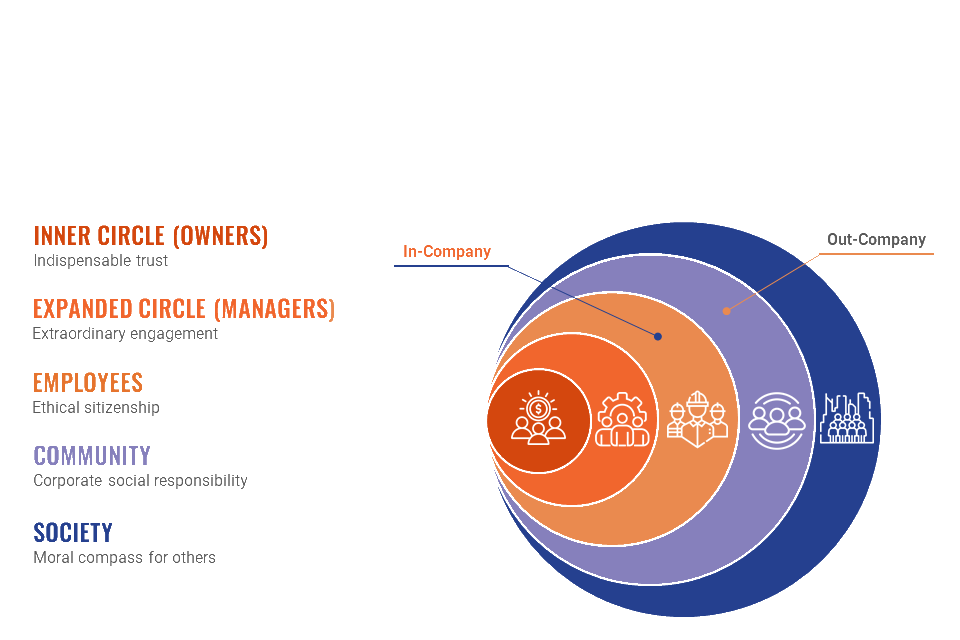
Expand Moral Circles
REASONABLE MORAL ATTITUDES
AND PRACTICES EXAMPLES:
Indispensable Trust
Expected moral stance among circle of close connections. In business these are usually owners of the business.
Extraordinary Engagement
Expected moral stance from managerial population toward organizational goals.
Ethical Citizenship
Expected moral stance from employees toward organizational goals
Corporate Social Responsibility Expected moral stance from organization toward community challenges
Moral Compass
Expected moral role the organization to play in social realm

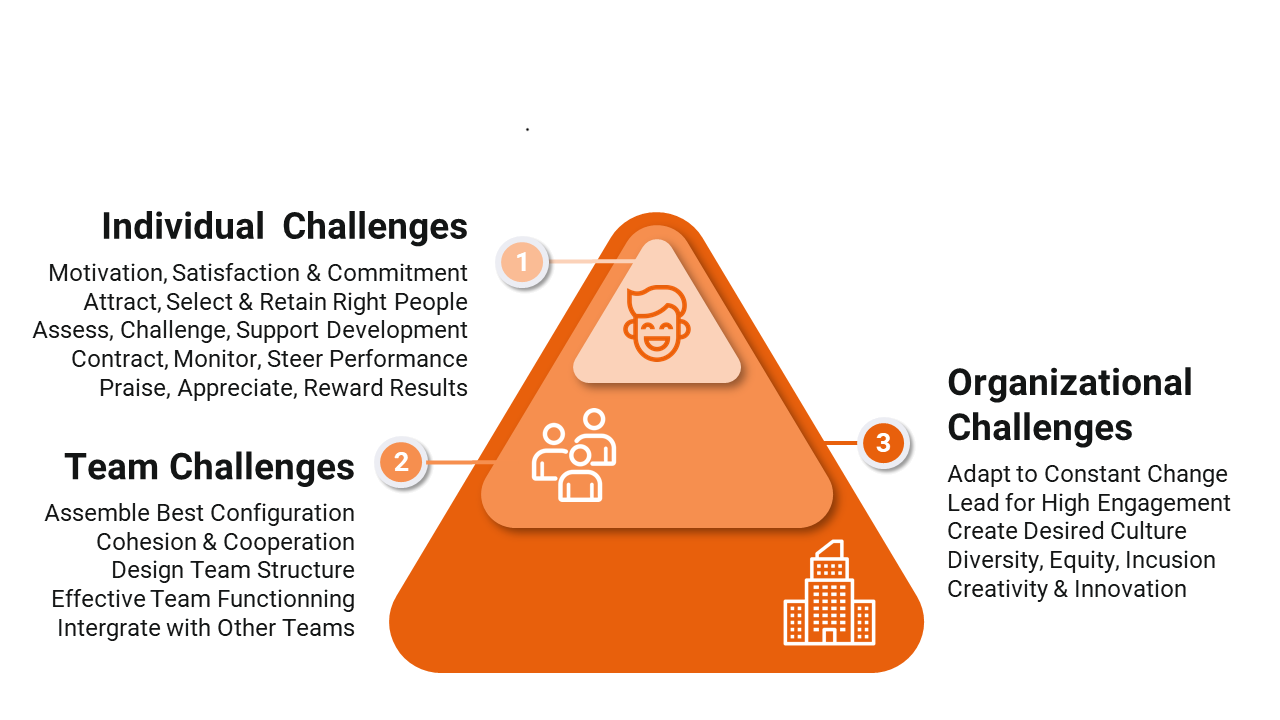
People Related Challenges
ALL PEOPLE RELATED CHALLENGES COULD BE DIVIDED INTO THREE GROUPS
Individual challenges
There are some things that reside inside the person. Like his/her knowledge about particular problem for example. To build successful team and organization, you have to have talented individuals at the first place and to develop these people at the second.
Team challenges
Individuals are valuable for organizational goals, if and only when they work collaboratively. Making people to act collaboratively is always challenge
Organizational challenges
Top companies are aware and willing to manage large scale organizational challenges as culture & change.

Match Person To The Role
PERSON/ROLE FIT COULD BE SEPARATED INTO THREE SUBFITS
Cultural fit depends on overlapping between individual goals of the person and organisational culture. Significant overlap predispose the person to experience the belonging to organisation as satisfying and rewarding and creates basic engagement. Without cultural fit, other fits are irrelevant.
Job/Role fit depends on overlapping between individual traits and associated with them natural behaviours with Job/Role demand. When person is doing what is natural for him/her, he/she experience state of flow and is successful too.
Knowledge/Skills/Experience fit depends on what person accumulated as a capabilities along the way and its usefulness for the current job.
Businesses helped
By Avantage
The right people
A correct fit
People Staying
Further progress
Avantage can help you with picking out the best people for your company.
Subscribe to Our Newsletter
Subscribe to
Our Newsletter
case studies, articles, tools and models. Simply type
in your email address and we’ll include you in our next update.

Avantage can help you with picking out the best people for your company.
Trusted by Leading
HR Directors and CEOs
Get in Touch
Sofia, 1304
Georgi.Djanamov@entalent.eu
+359 896 432400
ENTALENTOffice

AVANTAGEHeadquarters
OUR LOCATIONSWhere to find us

GET IN TOUCHAvantage Social links
Copyright by Entalent. All rights reserved.
Copyright by BoldThemes. All rights reserved.